
AI Discoverability & How to Win at AI Search?
Artificial intelligence has become the latest obsession in digital marketing. Businesses want to know how to rank in ChatGPT, how to appear in Google AI Overviews, and how to optimize for the next generation of search. Marketing blogs have responded exactly as expected, publishing endless checklists about AI SEO, prompt optimization, structured data, semantic search, and technical recommendations that promise to improve visibility inside AI-generated answers. Some of that advice has merit. Much of it is simply yesterday’s SEO advice wrapped in today’s terminology.
The problem is that these conversations begin with the wrong assumption. They assume artificial intelligence behaves like a traditional search engine, and that success depends on learning a new set of ranking factors. That mindset encourages businesses to chase algorithms instead of asking why certain organizations consistently become the answers AI chooses to recommend.
Artificial intelligence changes the mechanics of search, but it doesn’t change the fundamentals of trust. In many ways, it reinforces them. Rather than presenting users with a list of links and allowing them to decide which business appears most credible, AI attempts to make that judgment itself. It gathers information from multiple sources, looks for consistency, weighs evidence, and constructs an answer it believes deserves confidence.
That distinction changes the conversation entirely.
Winning at AI Search isn’t about convincing artificial intelligence that your website deserves to rank. It’s about making your business so easy to understand, validate, and trust that recommending you becomes the logical conclusion. Businesses searching for AI optimization techniques are often trying to solve the wrong problem. The organizations appearing most consistently within AI-generated answers aren’t necessarily the ones chasing the latest ranking signals. More often, they’re the businesses that have spent years building authority, publishing useful content, earning reviews, appearing in industry publications, speaking at events, and leaving behind a consistent trail of evidence that reinforces the same story wherever someone—or something—goes looking.
Search Engines Ranked Pages. AI Evaluates Businesses.
For more than two decades, success in search marketing was measured by rankings. The objective was simple: convince Google that one page deserved to appear ahead of another. Technical optimization, backlinks, content quality, page speed, user experience, and hundreds of other signals all contributed to that outcome, but the focus remained largely on improving the visibility of individual webpages.
Artificial intelligence introduces a different objective. Instead of deciding which page should appear first, AI is increasingly deciding which business deserves to be recommended. That recommendation isn’t based on a single webpage. It reflects a broader evaluation of everything AI can understand about your organization, your expertise, your reputation, and your consistency across the web.
This explains why some businesses with modest websites appear surprisingly often in AI-generated answers, while others with excellent technical SEO remain largely invisible. AI isn’t simply rewarding optimized pages. It is attempting to reduce uncertainty before presenting an answer to the user. The businesses that leave behind the clearest, most consistent body of evidence naturally become easier to recommend because there are fewer unanswered questions surrounding them.
The shift from ranking pages to evaluating businesses represents one of the most significant changes search has experienced since Google first transformed how information was organized online. It also explains why many organizations continue investing heavily in SEO while seeing fewer gains than they expected. The competitive advantage no longer comes solely from building a better webpage. It comes from building a business that is consistently understood across every place it appears.
How This Fits Into Your Marketing Strategy
Marketing Visibility Framework
Marketing Visibility extends beyond search rankings. It measures how easily your business can be found, understood, validated, and confidently recommended across search engines, AI platforms, review sites, industry publications, and every other digital touchpoint. AI Search doesn’t replace Marketing Visibility. It rewards it.
AI Doesn't Trust Marketing. It Trusts Evidence.
Every business has a story it wants customers to believe. Some position themselves as industry experts. Others promise exceptional service, innovative solutions, unmatched experience, or superior customer care. Most of these claims are made sincerely because business owners genuinely believe them. The challenge is that artificial intelligence has no reason to accept those claims at face value.
Just as buyers have become increasingly skeptical of marketing promises, AI looks beyond what businesses say about themselves. It searches for evidence that supports those claims. Customer reviews reinforce service quality. Educational content demonstrates expertise. Case studies illustrate real-world results. Podcast interviews, speaking engagements, industry awards, media mentions, certifications, and third-party references all contribute additional layers of validation.
None of these signals are particularly persuasive in isolation. Together, however, they reduce uncertainty. They allow artificial intelligence to compare what a business claims against what independent sources appear to confirm. The businesses leaving behind abundant, consistent evidence become easier to understand because their story no longer depends entirely on self-promotion.
This is one reason AI Search represents such an important shift for marketers. For years, businesses invested heavily in controlling the narrative through advertising, websites, and carefully crafted messaging. AI increasingly shifts the emphasis toward corroboration. The question is no longer, “What does this business say about itself?” Instead, the question becomes, “Can those claims be verified elsewhere?”
That subtle difference fundamentally changes how organizations should think about digital marketing.
Visibility Creates Confidence.
Many businesses still define visibility as appearing in search results. While rankings remain valuable, that definition no longer captures what visibility actually means in an AI-driven environment. Visibility is not simply about exposure. It is about understanding.
Artificial intelligence must first discover your business before it can evaluate it. Once discovered, it must understand what you do, who you serve, what problems you solve, and how your expertise differs from competing organizations. It must then determine whether those conclusions are supported consistently across multiple sources. Only after that process can confidence begin to develop.
Viewed this way, visibility becomes far more than traffic generation. It becomes the process of removing ambiguity. Every unanswered question, inconsistent message, outdated profile, neglected review platform, or disconnected marketing asset introduces uncertainty into that evaluation. Individually these issues may appear insignificant. Collectively they make your business more difficult for both people and artificial intelligence to understand.
The strongest brands don’t simply appear more often. They appear more consistently. Every interaction reinforces the same conclusion regardless of where that interaction takes place. That consistency becomes one of the defining characteristics of organizations that perform well across both traditional search and emerging AI experiences.
How This Fits Into Your Marketing Strategy
Visibility Formula
Visibility is measured by more than discoverability. It reflects the combined strength of your authority, content depth, trust signals, validation, accessibility, and consistency. The easier your business becomes to understand, the easier it becomes to recommend.
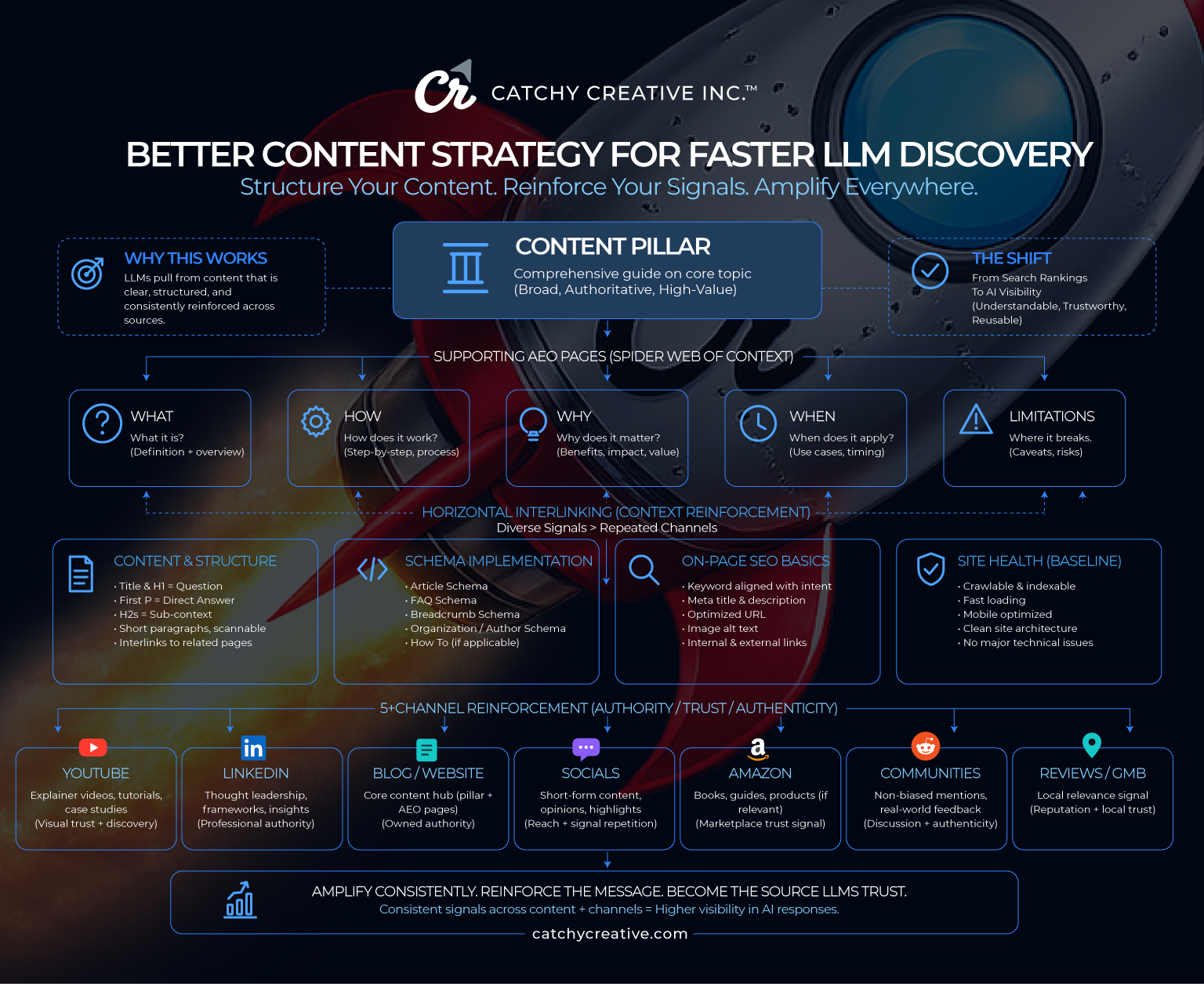
Every Marketing Asset Becomes Evidence.
One of the most common weaknesses uncovered during a Visibility Audit is disconnected marketing. Businesses often treat every marketing channel as though it exists independently. The website tells one story while LinkedIn emphasizes something different. Educational content speaks to one audience while advertising targets another. Podcast appearances are never referenced again. Speaking engagements disappear after the event. Valuable customer reviews remain hidden on third-party platforms.
Artificial intelligence doesn’t experience those channels individually. It experiences the patterns they create collectively.
Every article published on your website should reinforce your expertise. Every podcast appearance should strengthen your authority. Every customer review should validate your positioning. Every speaking engagement should become another piece of publicly available evidence. News articles, interviews, case studies, social media, videos, newsletters, and professional profiles all contribute to a larger body of information that helps AI understand your business with greater confidence.
Marketing channels should not compete for attention. They should reinforce one another. When they do, your visibility compounds because every new piece of evidence strengthens the credibility of everything that came before it.
The Businesses Winning AI Search Aren't Optimizing for AI.
This may be the most important realization businesses can make.
The organizations consistently appearing within AI-generated answers rarely built their marketing strategy around artificial intelligence. Most established their authority long before AI became part of everyday search behaviour. They answered customer questions publicly. They educated their industries. They invested in relationships, speaking opportunities, reviews, research, and thought leadership. They built businesses that became easy to understand because they consistently demonstrated expertise instead of simply claiming it.
Artificial intelligence rewards those behaviours because they reduce uncertainty. Businesses chasing shortcuts often focus on technical optimization while overlooking the broader challenge of becoming genuinely recognizable, credible, and trustworthy within their industries.
The goal isn’t to optimize for AI.
The goal is to build a business that AI can confidently explain.
How This Fits Into Your Marketing Strategy
Economics of Trust
As consumer risk increases, buyers require more evidence before making important decisions. Artificial intelligence follows a similar pattern. Higher-risk purchases demand stronger trust signals, broader validation, and greater confidence before recommendations are made.
AI Doesn't Search. It Builds Confidence.
Perhaps the biggest misconception surrounding AI Search is that artificial intelligence simply searches the internet more efficiently than traditional search engines. In reality, it performs a much more sophisticated task. It assembles confidence.
Every review contributes to that confidence. Every educational article, customer testimonial, podcast appearance, industry citation, speaking engagement, case study, media interview, and independent mention becomes another piece of evidence supporting a broader conclusion about your business. Individually, these signals rarely determine whether AI recommends you. Collectively, they shape how confidently artificial intelligence can answer questions about who you are, what you do, and why someone should choose you.
Businesses often ask how they can improve their visibility within AI Search. A better question is whether they have created enough publicly available evidence for AI to recommend them without hesitation. That distinction moves the conversation away from algorithm chasing and back toward the principles that have always produced strong marketing: demonstrating expertise, earning trust, maintaining consistency, and making credibility observable.
Artificial intelligence hasn’t rewritten the rules of marketing. It has simply raised the standard of proof.
Final Thoughts
Businesses looking for an AI optimization checklist are often asking the wrong question. Winning at AI Search isn’t about discovering the latest ranking factor or learning how to manipulate another algorithm. It is about becoming the business that deserves to be recommended.
Organizations that invest in authority instead of shortcuts, evidence instead of promises, and consistency instead of isolated campaigns are building something far more valuable than rankings alone. They are building confidence. That confidence influences buyers, strengthens search performance, improves AI discoverability, and reduces dependence on any single marketing channel.
In many ways, AI Search doesn’t represent a departure from good marketing. It represents its logical evolution. The businesses that succeed won’t necessarily be those producing the most content or chasing every new technology. They’ll be the ones that make it easiest for both people and artificial intelligence to arrive at the same conclusion.
They know what they do.
They know who they help.
And they have the evidence to prove it.