Why Most Content Never Shows Up in AI Search
AEO (Answer Engine Optimization) is the process of structuring content so it can be selected, reused, and surfaced in AI-generated answers and search results.
So, what is AEO? Is it actually something new, or is it just good marketing with a stricter filter?
That’s the question I keep coming back to.
AEO stands for Answer Engine Optimization. Search engines used to rank pages. AI systems now assemble answers. That shift is a core part of how marketing visibility works, especially as discovery moves beyond traditional search.
If content isn’t clear, structured, and grounded in real questions, it gets ignored by default. Not because it’s wrong, but because it isn’t usable. (See “Get to the Point Already – Writing for LLMs“)
That’s where most businesses struggle. They publish content, but it doesn’t get picked up, reused, or surfaced when it matters.
AEO doesn’t change what good marketing looks like. It just makes the gaps easier to see.
Here’s what that shift looks like in practice:
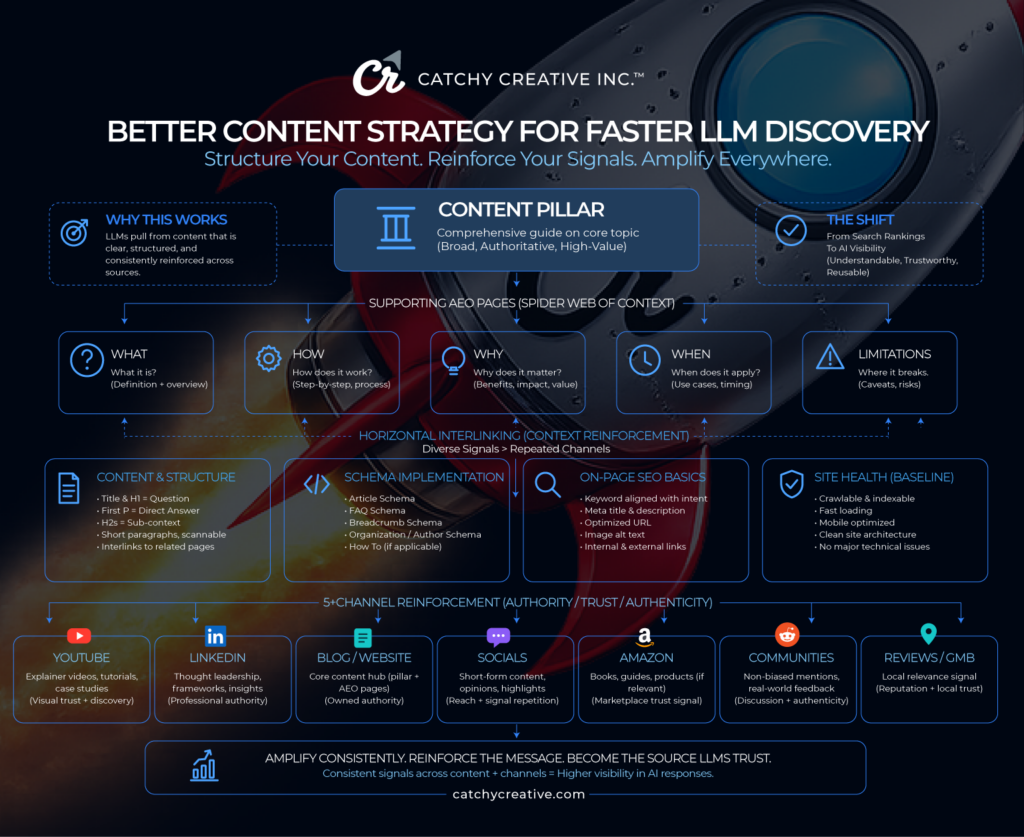
Content structure + signal reinforcement across channels is what drives visibility in AI-generated answers (see Channel Drift). Everything else on this page supports different parts of this system.
Want a deeper breakdown of how this works across channels?
See: Better Content Strategy for Faster LLM Discover.
In Simple Terms
- AEO is about structuring content so it can be selected and reused in AI-generated answers
- Search is shifting from ranking pages to assembling responses
- Content that isn’t clear or grounded in real questions gets ignored by default
- This isn’t a new strategy, but the consequences of doing it poorly are higher
What does AEO stand for?
AEO stands for Answer Engine Optimization.
It refers to structuring content so it can be selected and reused in AI-generated answers and search results.
But answering real customer questions? That part isn’t new.
For years, we’ve coached clients to build content around actual decision friction — not vanity keywords or bloated service descriptions. We’ve always pushed for pages that address pricing logic, timelines, tradeoffs, and fit. The advice hasn’t changed. What’s changed is the consequence of ignoring it. If you’re not sure where those gaps are showing up, start with an online visibility checklist.
AI doesn’t reward filler. It doesn’t reward vague positioning. It doesn’t reward “we’re proud to offer…” paragraphs that never resolve uncertainty. It filters them out.
That’s why I don’t see AEO as a revolution. I see it as quality control. → How Brands Get Noticed By AI Search
Weak content is getting trimmed.
The businesses that win won’t be the ones producing more. They’ll be the ones explaining better. SEO is no longer just about ranking pages. It’s about creating enough authority and presence across the web that people actually notice you when they begin researching solutions – visibility matters before conversion.
And this is where psychology enters the conversation.
There’s a well-known concept in behavioral research around the word “because.” Studies have shown that people are more likely to accept a request when a reason is given — even when the reason itself is simple. The word “because” signals logic. It answers the underlying “why.”
Strong explanations reduce cognitive load. A “because” statement isn’t filler — it guides thinking. It answers the why before someone has to ask it. That builds trust faster than broad claims ever could, because reasoning feels grounded and intentional rather than promotional.
Content works the same way.
It shouldn’t just answer the surface question. It should explain the reasoning behind the answer.
If someone asks, “Is this expensive?” a weak response says, “Our pricing is competitive.” A stronger response says, “It depends on scope, because long-term complexity and implementation requirements usually drive total cost.”
The difference is subtle but powerful. The second answer reduces uncertainty. It connects logic to reassurance — and that’s exactly the kind of clarity AI systems are more likely to reuse.
AEO Isn’t New.
It’s Q&A Content With Consequences.
👉 If you’d like coaching on building better consumer centric content, book a strategy call.
AEO vs SEO: What’s the difference?
SEO focuses on ranking pages in search results.
AEO focuses on structuring content so it can be selected and delivered as a direct answer.
SEO helps people find your content.
AEO helps your content get used.
AEO favours reasoning. But before reasoning comes recognition.
One of the biggest mistakes businesses make is jumping straight to the solution without acknowledging the question. People don’t just want information. They want to feel understood. If the content doesn’t recognize the tension behind the question, it feels generic.
Tools Reveal Questions, But Conversations Reveal Intent
This is where tools like Answer the Public and Google Trends become useful. They don’t tell you what to write — they reveal what people are already wondering about. You can see the phrasing, the anxieties, the recurring themes. That’s signal.
Recurring Questions Are Your Best Content Signals
Still, your most valuable data doesn’t come from tools. It comes from conversations. The questions that show up in sales calls. The hesitation in DMs. The objections in reviews. If a question keeps resurfacing, it deserves a clear public answer.
That has always been good practice.
The difference now is that AI systems amplify clarity and ignore noise. If your explanation is structured, reasoned, and genuinely helpful, it can be reused. If it’s thin or generic, it quietly disappears.
If you want to go deeper into the operational side of this shift, Josh Grant wrote a strong piece on question mining and explanation systems that reinforces the same core principle: visibility increasingly belongs to whoever explains something most clearly. It’s worth the read: The Definitive Guide to Question Mining
How This Fits Into Your Marketing Strategy
Channel Dependency Matrix
Channel dependency reflects how reliant your business is on specific marketing channels and how misalignment between channels can reduce effectiveness and increase risk.
Price Sensitivity Matrix
Price sensitivity reflects how customers evaluate cost relative to perceived value and how positioning and timing influence buying decisions.
What is AEO - Well, it's not exactly new.
It’s accountability.
It’s the market saying: explain it properly, or someone else will.
And in an AI-driven discovery environment, “properly” means recognizing the question, answering it clearly, and explaining why — because reasoning builds trust.
Interested In Fixing What Traditional SEO & Undisciplined PPC Have Broken?
Modern visibility depends on more than rankings and clicks. Learn how fragmented marketing systems weaken trust, visibility, and conversion performance across the buyer journey.
Frequently asked questions about AEO
AEO in marketing is the process of structuring content so it can be selected, reused, and surfaced in AI-generated answers, search results, and voice assistants.
No. AEO builds on SEO. Ranking still matters, but content now also needs to be structured so it can be reused and surfaced as an answer.
AEO is important because discovery is shifting from clicking links to receiving answers. Content that is clear, structured, and grounded in real questions is more likely to be selected and reused.